Choosing the right real estate agent isn’t about finding the person with the most signs in your neighborhood. Look for proven expertise, specialized systems, serious negotiation skills, clear communication, strong results, and a professional who can explain exactly how they create value for you. The best agent isn’t necessarily the most visible one. It’s the one most qualified to produce the outcome you need.
That’s the short answer.
Now let’s talk about why so many people get this wrong.
There are a lot of real estate agents in Dallas-Fort Worth. A lot.
That makes finding an agent incredibly easy.
Finding the right one is a different problem.
Most consumers don’t buy and sell homes every week. Hopefully you have other things to do. So when it’s time to hire a Realtor, people naturally reach for signals they recognize.
I’ve seen her signs everywhere.
He sells a lot in our neighborhood.
She’s with that giant brokerage.
He’s been doing this forever.
My cousin knows somebody.
She’s got a great Instagram account.
Fine.
None of those things automatically make someone a bad real estate agent.
They don’t prove they’re a great one either.
You’re about to trust someone with a transaction worth hundreds of thousands of dollars. Maybe much more.
Ask better questions.
What Should You Look for When Choosing a Real Estate Agent?
Start with the things that can actually affect your outcome.
- Expertise
- Negotiation
- Systems
- Process
- Specialization
- Communication
- Proven results
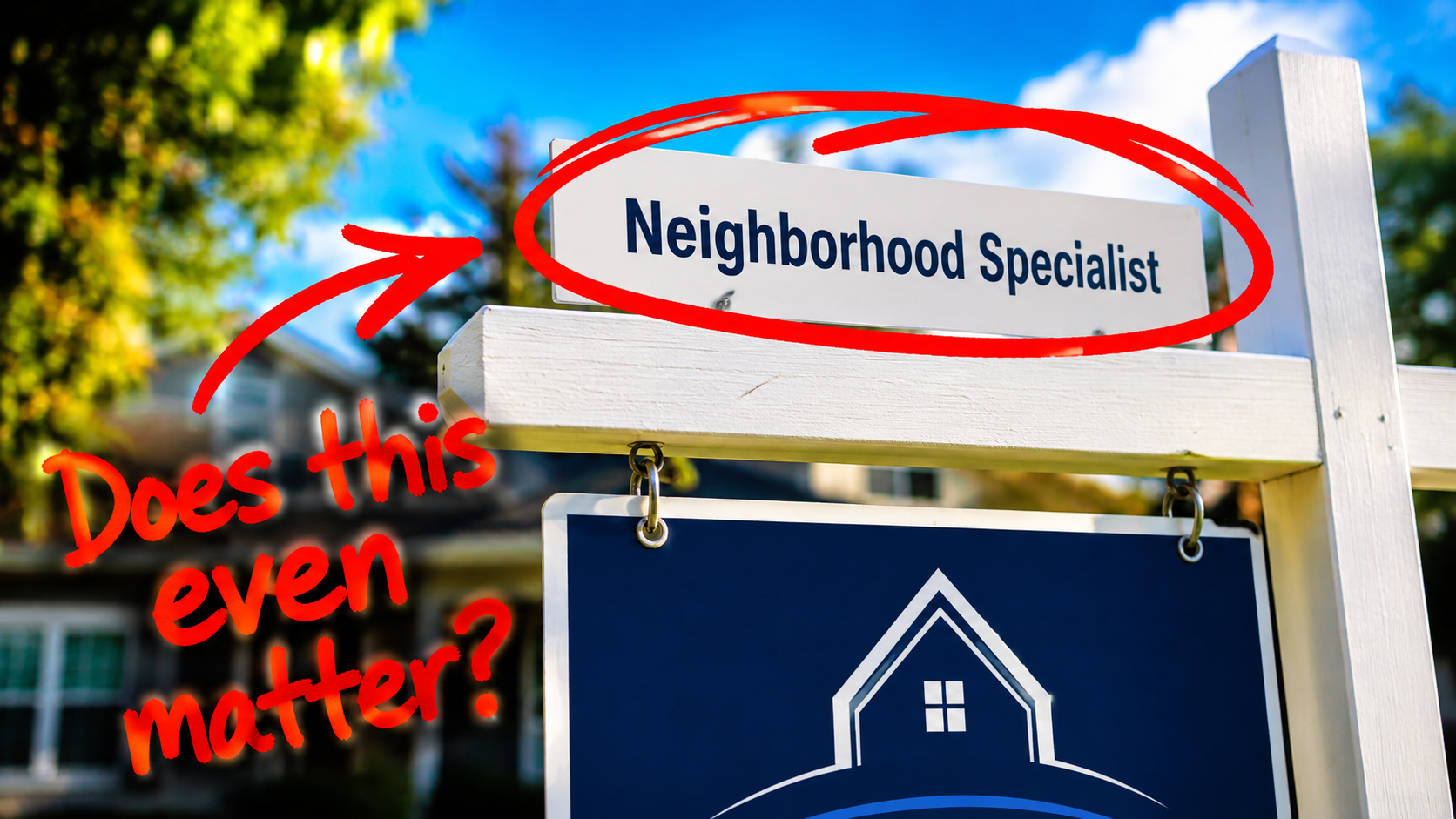
Those things aren’t as easy to put on a yard sign as “Neighborhood Specialist,” but they’re considerably more important when you’re sitting across from an inspection report, evaluating competing offers, deciding whether a house is overpriced, or trying to keep a transaction together three days before closing.
A real estate license tells you someone has met the state’s requirements to practice real estate.
Good. That’s where the evaluation starts, not where it ends.
The question isn’t whether somebody is allowed to represent you.
The question is whether you want them representing you.
Big difference.
Does a “Neighborhood Specialist” Make the Best Realtor?
Maybe.
I’ve been doing this for more than 20 years, and one of my favorite real estate signs is the little rider underneath the agent’s name that says:
“NEIGHBORHOOD SPECIALIST.”
It sounds impressive.
What does it actually mean?
Sometimes it means you’re dealing with an exceptional agent who knows the community deeply and is also an outstanding marketer, negotiator, strategist, and professional.
Fantastic.
Hire that person.
Other times it means they’ve lived there for 30 years and know everybody’s business.
That’s not quite the same thing.
Knowing where the Fourth of July parade starts is useful.
Knowing how to protect $40,000 of your equity is more useful.
Knowing which teacher everybody loves may be helpful information.
Knowing how to position your home against competing inventory, create buyer demand, negotiate effectively, manage risk, and get the transaction closed matters more.
If I had to choose between an agent who knew every person in the neighborhood but was average at marketing and negotiation, or a world-class marketer and negotiator who had to spend some time researching the neighborhood, I’m taking the world-class professional.
Every time.
Ideally, you get both, but don’t confuse familiarity with expertise.
Does the Biggest Real Estate Brokerage Have the Best Agents?
No.
A big brand can be a good company.
A small brand can be a good company.
There are excellent agents at enormous national brokerages, independent companies, virtual brokerages, and specialized real estate teams.
The logo alone tells me almost nothing about the quality of your representation.
People who have bought and sold several homes tend to figure this out.
The national brokerage isn’t negotiating your offer.
The logo isn’t answering the phone when an appraisal comes in low.
The corporate website isn’t figuring out how to handle a repair dispute.
Your agent is.
The team around your agent may be.
The systems supporting them may be.
Those are worth investigating.
Brand recognition is not the same thing as competence.
The Dallas Cowboys have one of the biggest brands in sports.
I’ll leave it there.
Don’t Hire an Agent Because You Recognize Their Face
This one gets our industry in trouble.
Real estate agents love putting their faces on things.
- Signs
- Billboards
- Postcards
- Benches
- Magnets
- Calendars
I have no problem with an agent marketing himself or herself. We’re business owners. People need to know we exist.
But there’s an important distinction.
Is the agent good at marketing themselves?
Or are they good at marketing YOUR property?
Those are not the same skill.
Seeing someone’s face everywhere can create familiarity. Familiarity can create trust.
But before you hand over one of your largest financial assets, go one step further.
- What are they actually good at?
- What can they do for you?
- What does their marketing system look like?
- What happens after they get the listing?
- What do they do that another competent agent doesn’t?
If the answer is basically, “Everybody knows me,” keep asking questions.
Should You Hire a Real Estate Generalist or a Specialist?
I believe specialization matters.
Imagine an agent tells you, “I do residential sales, commercial real estate, leasing, property management, farms, ranches, land, investments, new construction, luxury, first-time buyers, and probably aircraft carriers if you happen to have one.”
Some consumers hear that and think, “Wow. They can do everything.”
I hear it differently.
What are you world-class at?
Real estate is complicated enough without pretending every part of it is the same.
If you’re selling a home in Dallas-Fort Worth, you want somebody who is freakishly knowledgeable about selling homes.
If you’re buying, you want a professional with a real buyer process, not somebody improvising every time the phone rings.
Specialization creates repetitions.
Repetitions create pattern recognition.
Pattern recognition matters when something unusual happens.
And something unusual eventually happens.
How Important Is Negotiation When Choosing a Realtor?
Massively important.
Consumers consistently identify negotiation as one of the most valuable things they expect from an agent.
They’re right.
But most people misunderstand what real estate negotiation actually is.
They think it starts when somebody submits an offer.
Nope.
Negotiation begins much earlier.
How your agent communicates matters.
What information they reveal matters.
What information they DON’T reveal matters.
How quickly they respond matters.
How your property is positioned matters.
How an offer is written matters.
How a counteroffer is delivered matters.
Price matters, obviously, but so do time, repairs, contingencies, possession, appraisal issues, financing, liability, and dozens of other variables.
And here’s something most consumers don’t know.
Getting a Texas real estate license does not require someone to become an expert negotiator.
That’s a pretty significant gap between what consumers expect and what licensing alone guarantees.
So ask:
- “How have you trained in negotiation?”
- “How do you approach negotiation?”
- “Tell me about a situation where your negotiation strategy materially improved a client’s outcome.”
Listen to the answer.
You’re not looking for the agent who says, “I’m a bulldog.”
Being obnoxious isn’t a negotiation strategy.
You want someone capable of pushing hard when necessary without destroying relationships and giving away tomorrow’s options just to feel like they won today.
That’s a professional negotiator.
Ask the Agent What They Do Differently
This may be the single best question you can ask:
- “What do you do that other real estate agents don’t?”
Then stop talking.
A serious professional should have an answer.
- Not a slogan.
- Not “I care more.”
- Not “I’m available 24/7.”
- Not “I work really hard.”
I hope so.
- Those are minimum expectations.
- What is the process?
- What is proprietary?
- What have they built?
- What training do they complete?
- How do they market differently?
- How do they negotiate differently?
- How do they help buyers make better decisions?
- How do they reduce your risk?
- What happens when something goes wrong?
- How can they prove any of it?
Great agents know where their value comes from.
Average agents tend to describe their personality.
Look for Systems, Not Heroics
This matters more than people realize.
You don’t want a real estate transaction that succeeds because your agent performed some heroic act at 11:47 p.m.
You want a transaction designed to avoid needing heroics in the first place.
Systems aren’t exciting.
They’re valuable.
At the Todd Tramonte Home Selling Team, we have a 13-point buyer program. We have a proprietary seven-step marketing system for sellers. Our agents go through an intensive six-week training process, followed by ongoing training that doesn’t stop because somebody passed a licensing exam.
Why?
Because we’re not interested in being average agents.
Our clients shouldn’t have to accept average representation.
Real estate transactions are too expensive for that.
The best systems create consistency.
They make it less likely that important details depend on whether your agent remembered something while driving down the Tollway.
That’s a good thing.
Watch How the Agent Communicates Before You Hire Them
You can learn a lot before signing anything.
- Do they listen?
- Do they answer questions directly?
- Do they explain complicated things simply?
- Do they tell you something you don’t want to hear when it’s true?
That’s a big one.
If you’re selling and every agent tells you your home is worth $650,000, but one tells you it’s worth $595,000, don’t automatically assume the $650,000 agent is better.
Ask them to prove it.
Sometimes agents tell sellers the number they think will win the listing.
That’s not expertise.
That’s an audition.
You don’t need an agent who agrees with everything you say.
You need one who is willing to tell you the truth before the truth gets expensive.
The same applies to buyers.
If every house is “amazing,” you’ve hired a cheerleader.
A great buyer’s agent should occasionally tell you, “No. I don’t think you should buy this house.”
That’s representation.
How Can You Tell the Wrong Real Estate Agent From the Right One?
The wrong agent isn’t necessarily dishonest or lazy.
That’s important.
Plenty of average agents are wonderful human beings.
I’d happily have dinner with them.
I just wouldn’t necessarily give them responsibility for a major financial transaction.
The wrong agent for you may simply lack the specialization, systems, experience, training, or communication style your situation requires.
Pay attention when an agent can’t explain their process.
Pay attention when all their differentiation is about themselves rather than you.
Pay attention when they make promises but can’t explain the strategy behind those promises.
Pay attention when they seem more interested in getting you to sign than understanding what you’re trying to accomplish.
And pay attention when everything sounds easy.
Real estate isn’t impossible.
But it isn’t HGTV either.
There are contracts, deadlines, inspections, appraisals, financing, title issues, negotiations, emotions, moving schedules, and occasionally some truly bizarre surprises.
You want someone who knows what to do when reality shows up.
The Best Real Estate Agent Is the One Who Creates the Most Value for You
That’s the whole game.
Not the biggest brokerage.
Not the most yard signs.
Not the prettiest headshot.
Not the person everybody at the neighborhood pool knows.
And certainly not automatically the cheapest agent.
Choose the professional who can demonstrate how they will create value in your specific situation.
If you’re selling, how will they help you maximize your outcome while managing time, risk, and stress?
If you’re buying, how will they help you identify the right opportunity, understand what you’re actually buying, negotiate effectively, and avoid expensive mistakes?
Ask them.
Make them show you.
A great agent will enjoy that conversation because great agents aren’t afraid of being compared.
They’ve built something worth comparing.
Frequently Asked Questions
What should I look for when choosing a real estate agent?
Look for proven expertise, strong negotiation skills, specialized systems, clear communication, relevant experience, and a track record of results. Focus on how the agent creates value for you, not simply how visible or well-known they are.
What questions should I ask a Realtor before hiring them?
Ask what they do differently, how they negotiate, what systems they use, how they communicate, what relevant results they can demonstrate, and how they would handle your specific buying or selling situation.
Should I choose the Realtor who sells the most homes in my neighborhood?
Not automatically. Neighborhood knowledge can be valuable, but marketing, negotiation, systems, specialization, and transaction expertise may have a greater effect on your outcome.
Does the real estate brokerage matter when choosing an agent?
The brokerage can provide useful resources, but the individual agent and team representing you matter much more. Evaluate their expertise, process, training, communication, and results.
How do I find a good real estate agent in Dallas-Fort Worth?
Interview agents based on their actual value rather than advertising alone. Look for DFW market knowledge combined with proven systems, specialized experience, negotiation training, strong communication, and documented client results.
Don’t Settle for Average Representation
The public’s opinion of real estate agents isn’t always flattering.
Some of it is deserved.
The answer isn’t to assume you don’t need a professional.
The answer is to hire a better professional.
At the Todd Tramonte Home Selling Team, we’ve spent more than 20 years building a business around the belief that real estate agents should deliver substantially more value than opening doors, putting homes in the MLS, and filling in blanks on contracts.
Our agents train.
We specialize.
We use proprietary buyer and seller systems.
We study negotiation.
We build processes designed to protect our clients’ time, money, and sanity.
And we believe you should expect that level of professionalism when you’re buying or selling a home in Dallas-Fort Worth.
If you’re thinking about making a move, don’t hire us because you’ve seen our name.
Talk to us.
Ask the hard questions.
Compare us.
Make us show you the difference.
Then decide.
Visit DallasHomeRealty.com or call 214-216-2161 to talk with the Todd Tramonte Home Selling Team about buying or selling your next home in Dallas-Fort Worth.

