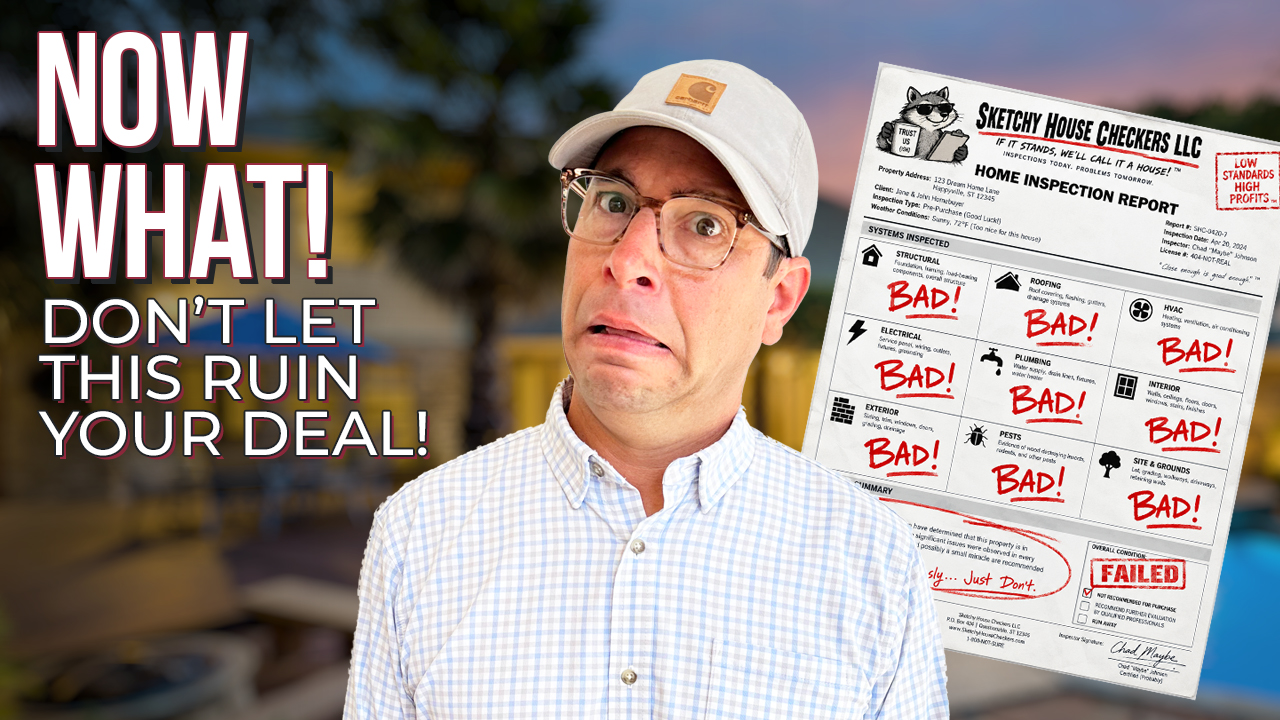
You got the inspection report.
It’s 41 pages long. There are photos. Red boxes. Yellow warnings. Words like “deficient,” “further evaluation,” and “potential failure.”
Naturally, you’re wondering if the house is about to fall down.
Probably not.
Home inspections are one of the most valuable parts of buying or selling a home, and they’re also one of the most poorly understood. Buyers get scared. Sellers get defensive. Agents sometimes make both worse.
It doesn’t have to happen that way.
After more than 20 years selling homes in Dallas-Fort Worth, I’ve watched plenty of perfectly good transactions get unnecessarily complicated because somebody misunderstood what an inspection report was supposed to accomplish.
So let’s get this straight.
A Home Inspection Is Not Pass or Fail
Your house did not fail the inspection.
It didn’t pass either.
That’s not what a home inspection does.
A home inspection is an observation of the condition of the major systems of a home on the day and at the time the inspection takes place. Those are important qualifiers.
An inspector can evaluate what is visible and accessible while they’re there. They can operate systems. They can identify deficiencies. They can recommend additional evaluation by a specialist.
They cannot tell you everything that has ever happened to a house or everything that will happen to it in the future.
Imagine an inspector evaluating a house in Dallas when it’s 101 degrees outside. Testing the air conditioner makes perfect sense. Getting the furnace to operate under normal conditions may be considerably more difficult.
The inspection is valuable.
It is also a snapshot.
Treating it as anything else creates expectations no inspector can possibly meet.
The Home Inspection Report Is Not a Shopping List
This may be the most important thing a DFW home buyer can understand:
The home inspection is not a shopping list.
If an inspector identifies 23 deficiencies, that does not automatically mean the seller should repair 23 things.
Could you ask?
Sure.
Should that be your strategy?
No.
You’re buying a house, not ordering one from a factory.
Actually, even brand-new homes have inspection deficiencies. Of course they do. A house is an enormous collection of complicated systems involving electrical wiring, plumbing, HVAC equipment, roofing, structural components, windows, appliances, drainage, materials, and thousands of individual parts.
Something is going to show up.
The question isn’t whether the inspector found something.
The better question is: What did the inspector find that actually matters?
The inspector was ALWAYS going to find something. It’s about understanding and working through what they find.
What Should You Focus on in a Dallas-Fort Worth Home Inspection?
For most resale homes in Dallas-Fort Worth, there are four major categories that deserve serious attention:
- Electrical
- Plumbing
- Structure and foundation
- Roofing.
Those aren’t the only things that matter. They are simply the areas where significant problems can become expensive enough or serious enough to change the economics of the transaction.
A faulty electrical panel or substantial fire hazard deserves attention.
A plumbing problem that could require extensive replacement or tunneling under a slab deserves attention.
Significant foundation movement or structural work deserves attention.
A roof requiring replacement or substantial repair deserves attention.
That’s very different from treating every line of the inspection report as though it carries equal weight.
It doesn’t.
A failed GFCI outlet and a major foundation problem may both appear as deficiencies on an inspection report. They are not remotely the same level of concern.
What Inspection Problems Should Buyers Be Worried About?
Start with magnitude.
If the inspection reveals a potentially major electrical, plumbing, structural, or roofing problem, get serious about understanding it.
I didn’t say panic. Don’t do that. Understand it.
A general home inspector may recommend that you bring in an electrician, plumber, HVAC contractor, structural engineer, roofer, or another specialist. That does not automatically mean there is a catastrophic problem.
It means the inspector recognizes the limits of a general home inspection and believes somebody with deeper expertise should evaluate that particular system.
That’s exactly what a good inspector should do.
A home inspector’s job is not to be a structural engineer, master plumber, electrician, roofer, HVAC technician, and every other specialist simultaneously.
Their job is to inspect the home as a whole and tell you where additional investigation may be appropriate.
Should You Worry About Every Deficiency on an Inspection Report?
No.
That doesn’t mean ignore small problems. It means understand them in proportion.
Fogging between window panes from failed seals can concern buyers.
Wood rot can concern buyers.
Improper soil grading can concern buyers.
A GFCI outlet that isn’t operating correctly can concern buyers.
A water heater valve can concern buyers.
Exterior cracks can really concern buyers, especially in North Texas.
A fireplace component that doesn’t operate or a pool gate latch that needs adjustment may appear on the report too.
All of those things deserve to be understood.
But an inspection report becomes dangerous when every deficiency is emotionally promoted to catastrophe.
That’s when buyers start walking away from homes they might otherwise love, and sellers start fighting over repairs that could have been resolved with a reasonable conversation.
The report gives you information.
What you do with that information determines whether it becomes useful or destructive.
Sellers: Consider Getting Ahead of the Inspection
Whoever controls the information has an enormous advantage.
That’s why we frequently discuss pre-listing inspections with our Dallas-Fort Worth home sellers.
Imagine two scenarios.
In the first, you list your home. A buyer puts it under contract. The buyer orders an inspection. Then you hear nothing for two days.
Finally, the buyer’s agent calls.
There are 41 issues. The buyers are freaking out. They’ve started calling contractors. Somebody thinks repairs could cost tens of thousands of dollars. The buyer is considering terminating.
That’s a pretty unpleasant way to start your day.
Now imagine that before your home ever went on the market, you had it inspected.
You already knew the issues.
You and your agent decided what should be repaired, what should be investigated further, what didn’t need action, and how the remaining issues should be handled with prospective buyers.
The buyer still gets their own inspection, which they absolutely may (and should) choose to do, but now they come back with three concerns.
That’s a far easier situation to negotiate through.
Instead of reacting to a hand grenade somebody just tossed into your transaction, you’re discussing information you’ve already seen and thought through.
That is a much stronger position for a seller.
Should Dallas-Fort Worth Home Sellers Fix Everything Before Listing?
No.
A pre-listing inspection isn’t valuable because it gives you an enormous repair list.
It’s valuable because it gives you information.
Some problems may be worth correcting before you list. Some may deserve a specialist’s opinion. Some may be better disclosed and addressed another way. Some may be relatively insignificant.
The right answer depends on the property.
A 1994 suburban home connected to municipal utilities presents one set of inspection questions. A five-acre property with a well and septic system presents another.
That’s why generic real estate advice falls apart pretty quickly.
The house matters.
The location matters.
The systems matter.
The contract matters.
And the people representing you matter.
What Does “As Is” Mean for a Home Inspection?
“As is” does not necessarily mean “don’t inspect.”
A buyer can still benefit tremendously from understanding the condition of a property even when a seller has communicated that they don’t plan to make repairs.
And circumstances can change.
Information discovered during an inspection can affect how buyers and sellers decide to proceed, depending on the contract and the specific transaction.
“As is” should never be translated into “I don’t want to know.”
Knowing is the point.
Should Buyers Attend the Home Inspection?
You generally can, but that doesn’t mean you need to follow the inspector around for several hours.
There can be tremendous value in seeing important findings firsthand and asking appropriate questions, but your goal isn’t to become a home inspector before lunch.
Your goal is to understand the property you’re considering purchasing, and that’s often done most effectively when you come at the end of the inspection to review the findings with the inspector.
Get the information.
Ask good questions.
Then make decisions with people who understand what that information actually means.
Homes on Land Require Different Inspection Questions
This is particularly important around Dallas-Fort Worth, where buyers can move surprisingly quickly from traditional suburban neighborhoods into homes sitting on half an acre, one acre, three acres, or five acres.
Those properties are different.
A house may have a well instead of municipal water. It may use a septic system instead of municipal sewer. Utilities may be located far from where a buyer wants to construct another building. Vacant land introduces questions about where and what you can build.
A normal whole-home inspection doesn’t magically answer every one of those questions.
You need the right experts.
And you need a real estate agent who either knows the answer or knows exactly who should be brought in to get it.
Pretending to know everything is not expertise.
Knowing what matters and who to call is.
The Best Way to Use a Home Inspection Report
A home inspection report should help you make a better decision.
For buyers, that means understanding the property's true condition, separating major concerns from manageable ones, bringing in specialists when needed, and deciding which issues deserve to become part of a repair or negotiation conversation.
For sellers, it means eliminating unnecessary surprises, preparing intelligently, and understanding the condition of the product you’re putting on the market.
Fear is expensive.
So is ignorance.
Good information handled by people who know what they’re doing can save a tremendous amount of both.
The goal isn’t a perfect inspection report.
I’ve been doing this for more than two decades. Perfect houses aren’t really a thing.
The goal is clarity.
Know what you’re buying. Know what you’re selling. Understand what matters. Deal with the big stuff like adults and don’t destroy a good transaction over something that can be solved reasonably.
That’s the whole game.
Dallas-Fort Worth Home Inspection FAQ
Can a house fail a home inspection in Texas?
No. A standard home inspection isn’t a pass-or-fail test. It documents observable conditions and deficiencies in the home at the time of inspection.
What are the biggest inspection concerns for DFW home buyers?
Major electrical, plumbing, structural, foundation, and roofing issues typically deserve the closest attention because significant problems in these areas can materially affect a transaction.
Should I ask the seller to repair everything on the inspection report?
Usually, no. An inspection report isn’t a shopping list. Buyers should understand the significance of each issue and determine which items genuinely deserve further evaluation, repair, or negotiation.
Should a seller get a pre-listing home inspection?
It can be extremely valuable. A pre-listing inspection can identify potential issues before buyers discover them, giving the seller time to understand the property and develop a strategy before going under contract.
Does an “as is” sale mean I shouldn’t get an inspection?
No. An “as is” sale does not make information less valuable. An inspection can still help a buyer understand the property’s condition and make a better-informed decision.
Who should explain serious problems found during an inspection?
Depending on the issue, further evaluation may require a specialist such as a structural engineer, electrician, plumber, roofer, HVAC professional, or septic inspector. A strong real estate agent should help you navigate that process and connect you with the appropriate experts.
Buying or Selling a Home in Dallas-Fort Worth?
Don’t let an inspection report become the scariest document in your transaction.
The Todd Tramonte Home Selling Team helps DFW buyers and sellers understand what matters, find the right experts, negotiate intelligently, and move forward with clarity.
If you’re buying or selling your next home in Dallas-Fort Worth, work with a full-time team that knows how to navigate this stuff.
Visit DallasHomeRealty.com or call 214-216-2161.

