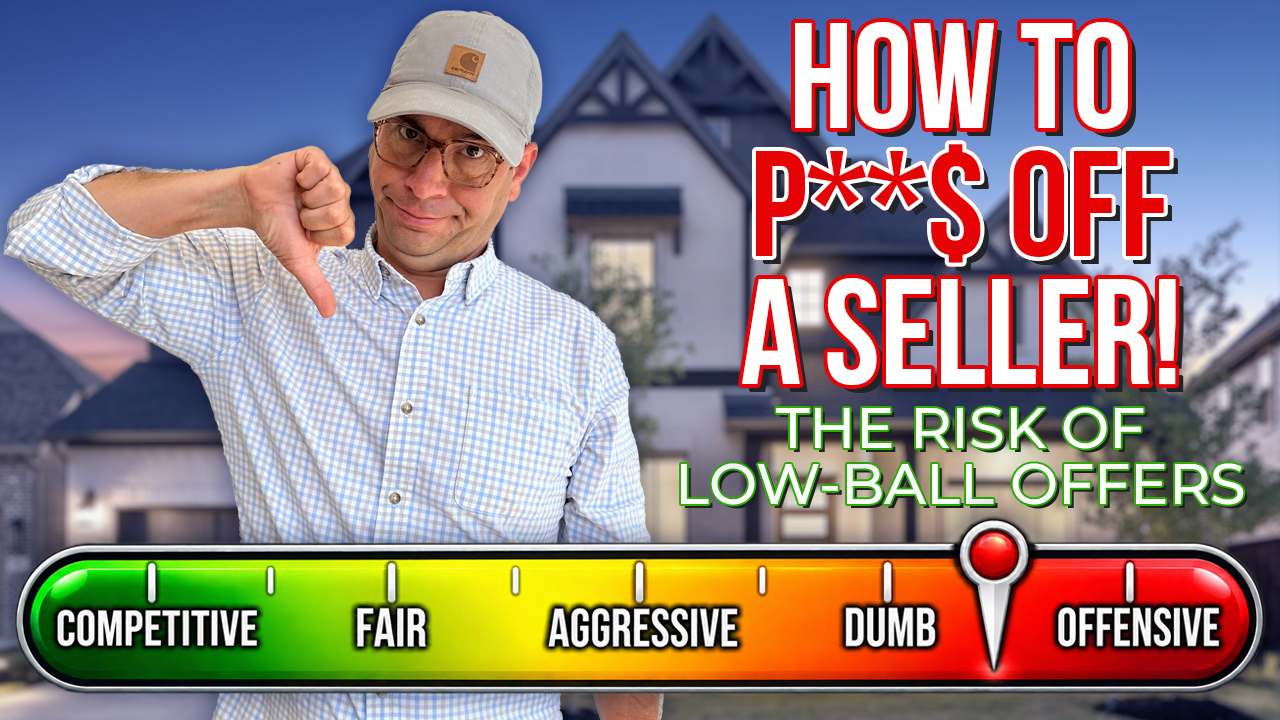
 Almost never.
And the few times a lowball offer looks like it worked, the buyer usually pays for it later.
Here's the short answer. A lowball offer is an offer far below the asking price with no reasoning behind the number. In Dallas-Fort Worth, it rarely gets a buyer the best deal. A seller who feels insulted stops cooperating, so even an accepted lowball tends to cost the buyer during inspections, repairs, and closing. An offer well below asking can work when it's based on what the home is worth and what the seller's situation is, and when somebody explains the number.
People have been told for decades that you throw out a low number, the seller counters, and everybody meets in the middle.
We spent a full episode of DFW Real Estate Weekly on why that's bad advice. I'm not saying buyers are stupid. I'm saying a lot of buyers are doing this one stupid thing, and then blaming the lender, the inspector, and the agent when it goes sideways.
What Counts as a Lowball Offer on a House?
A lowball offer is one that's unreasonably below the asking price, meaning there's no reason behind it.
I'm not going to give you a percentage. There isn't a line where 19% under asking is fair, and 21% is an insult.
Any offer under asking is a low offer. Nothing wrong with that.
It becomes a lowball when nobody did any work. Nobody figured out what the home should sell for, or the buyer disregarded the agent's advice on price. Nobody asked about the seller's situation. Nothing about your timing or your terms explains the number. You just picked something low to see what would happen.
That also means a very low offer isn't automatically a lowball. If a seller is asking 80% more than the home is worth, offering half of the asking price could be completely reasonable.
Is the Asking Price What the Home Is Worth?
Not necessarily. The asking price is the headline of the advertisement.
Somebody picked it. Sometimes they did the math. A lot of the time it came from the seller's feelings, a neighbor, a father-in-law, an online estimate, or AI. Those are all bad places to get a property value.
Then a buyer who's trying to be smart measures the whole purchase against that number.
"We got it for less than asking."
"We had to pay over asking."
Neither sentence tells you if you got a good deal. I've written before about how price and value are two different things, and it applies here more than anywhere.
Figure out what the home is worth first. The offer comes after that.
Why Doesn't "Offer Low and Meet in the Middle" Work?
It fails because the seller's first reaction to you sets the tone for everything after it.
Say a home is worth $500,000. Similar homes nearby have sold for about that. It's clean, it shows well, and it's marketed well.
You offer $390,000.
The seller isn't thinking, "Well, that's something to consider." The seller thinks you're either a jerk or you have no idea what you're doing.
Here in the fall of 2026, I hear a lot of buyers say, "Let's just see if they'll take it." Those same buyers don't think about how they would feel if they were the seller receiving that low offer.
They say it without knowing if there are other offers. They don't know if the seller has already moved out. Most of the time, they don't know what the home is worth either.
If that seller has seven offers at or above asking, yours never gets a second look.
What Happens When a Lowball Offer Gets Accepted?
You get the price and lose the seller's cooperation.
Let's say it "works." You started at $390,000 and somehow talked the seller down from $500,000 to $450,000. You feel great about your strategy.
Then your lender needs one more day to close.
No.
You're short on cash at closing and ask the seller to pay for the survey.
No.
The inspection turns up some wood rot on the front of the house, and your agent sends over an amendment asking for the repair.
No.
Your loan won't get approved unless the soil grading gets fixed.
"I'm moving on."
A home purchase has a lot of small requests after the price is settled. A seller who feels respected says yes to plenty of them. A seller who feels like you took advantage of them has no reason to say yes to any of them, and some of those contracts never make it to closing.
A blind lowball might work once or twice out of a thousand. Sometimes you get absurdly lucky, but it's rare. Even then, this is what you get to deal with afterward. It costs you money, time and sleep.
When Does an Offer Far Below Asking Make Sense?
It makes sense when you have a reason and some leverage.
Maybe the home is badly overpriced and you can show why.
Maybe there are no other offers, the seller has already moved to another city, and they're paying two mortgages.
Maybe it's an estate, and the family cares more about being finished than about the last dollar. Some sellers would rather have you take the place as-is than spend a month cleaning it up.
Those situations are rare. You also only find out about them by asking questions, which most buyers and plenty of agents never do.
Investors are a separate case. Some of them make a hundred offers to get one or two accepted at 40% or more below market value. That's a numbers game. It's legal. It isn't something I get excited about helping with, and it's no way to buy a house you want to live in.
How Do You Offer Less Without Insulting the Seller?
Give the reason before you give the number.
Here's what that sounds like when a good buyer's agent calls the listing agent:
"This is a beautiful house, and you've done a great job getting it ready. My clients love it. Here are the four reasons they can't pay $500,000. Would your seller be open to an offer that's a good bit lower, or should I tell them to move on?"
Nobody's offended by that call. The seller might be disappointed, and they can live with disappointed.
Sometimes the answer is, "We have four other offers, so don't waste your time writing that up." Good. Now you know, and you didn't burn anything down finding out.
Sometimes the answer is that there's room.
I'm doing this myself right now. For about two months I've been talking with an owner about a property I might buy as an investment. I told them plainly that I didn't know where their original number came from and that I couldn't make a return at that price. I haven't made an offer. They've come down almost $200,000, which is close to half of what they first asked.
I still may not buy it, but they know why, and nobody's mad.
We're glad to help you pay the lowest price a seller is honestly willing to take. That's what skilled negotiation is for.
One practical note for this market: If your budget is $400,000, don't tour $500,000 homes and hope. You might be able to look at $430,000 homes. Depending on the area, you may find something seven, eight, or nine percent below market value right now. Ten, 20, or 30 percent takes an unusual situation.
Does Your Agent's Reputation Affect Your Offer?
Yes. The listing agent remembers how your agent behaved the last time.
You might not care what some other agent thinks about your agent from a deal a year ago.
You should.
If your agent insulted a listing agent twice with offers that had no reasoning and no communication, and that same listing agent now represents the house you want, your offer starts in a hole. Even a listing agent who's trying hard to be professional will let it leak when they present your offer to their seller.
"The offer's okay. It's low. They want a 10-day option period, and most people ask for seven."
Nobody said your agent was a jerk. Nobody had to.
So when you're interviewing agents, ask this: "What's your offer strategy?" Ask how they pick a number, how they communicate it to the other side, and what they look at besides the payment you can afford.
Many think haggling is simply how you buy a house. List it high, expect a low offer, settle somewhere in between. A lot of buyers here learned the same thing from their parents and grandparents.
It's time to retire it.
What Does This Mean If You're Selling?
It means your asking price deserves more thought than most agents give it.
You need to know what your home is worth. But typing that number in as the asking price is a poor way to price a home, and most agents don't have another method.
Ask the agents you interview how they decide on an asking price. Ask how they plan to bring you higher offers and cleaner ones, with fewer requests after you're under contract. A strong asking price strategy also makes it easier when you're comparing offers.
If you'd like a starting point, you can get your home's value in seconds.
Frequently Asked Questions
Do lowball offers work on houses?
Rarely. Most are rejected or ignored, especially when the seller has other interest. When one is accepted, the seller is often unwilling to help with repairs, closing dates, or other requests later, and some of those contracts never close.
What is considered a lowball offer on a house?
A lowball offer is one that's unreasonably below the asking price, with no reasoning behind it. There's no set percentage. An offer far below asking that's based on the home's real value and the seller's situation isn't a lowball.
How much below asking price should I offer on a house in Dallas-Fort Worth?
It depends on what the home is worth, which may be more or less than the asking price. In the fall 2026 market, some buyers are finding homes seven to nine percent below market value depending on the area. Bigger discounts usually take an unusual seller situation.
Is it rude to offer less than the asking price?
No. Offering less is normal. What offends sellers is a very low number with no explanation. Having your agent share the reasons before sending the offer keeps the conversation respectful.
When does a very low offer make sense?
When the home is overpriced, when the seller has no other offers and is motivated to move on, or when a seller cares more about a fast, as-is sale than about top dollar. Your agent should confirm the situation before you write the offer.
Buying or Selling in Dallas-Fort Worth? Start With a Strategy.
There are still great deals to be had on homes in DFW. Getting one takes more than the lowest number you can think of.
Every agent on the Todd Tramonte Home Selling Team is full-time and works exclusively with either buyers or sellers. Our buyer specialists have tons of experience understanding a home's value and crafting compelling offers that help their buyers achieve their goals.
We guarantee to help you buy a home and save at least $5,000 throughout the purchase process. And when you sell, we guarantee to sell your home over the average price and under the average time. Our Buyer Advantage Program and our Over/Under System deliver proven results for our clients time and time again.
More than 900 people have left us five-star reviews on Google. Every one of them is somebody telling you what it was like to work with us.
To buy or sell a home in Dallas-Fort Worth with the Todd Tramonte Home Selling Team, visit DallasHomeRealty.com or call 214-216-2161.
:format(webp):quality(80)/u.realgeeks.media/dallashomerealty/modern-home-large-red.png)
:format(webp):quality(80)/u.realgeeks.media/dallashomerealty/map-search-black.png)