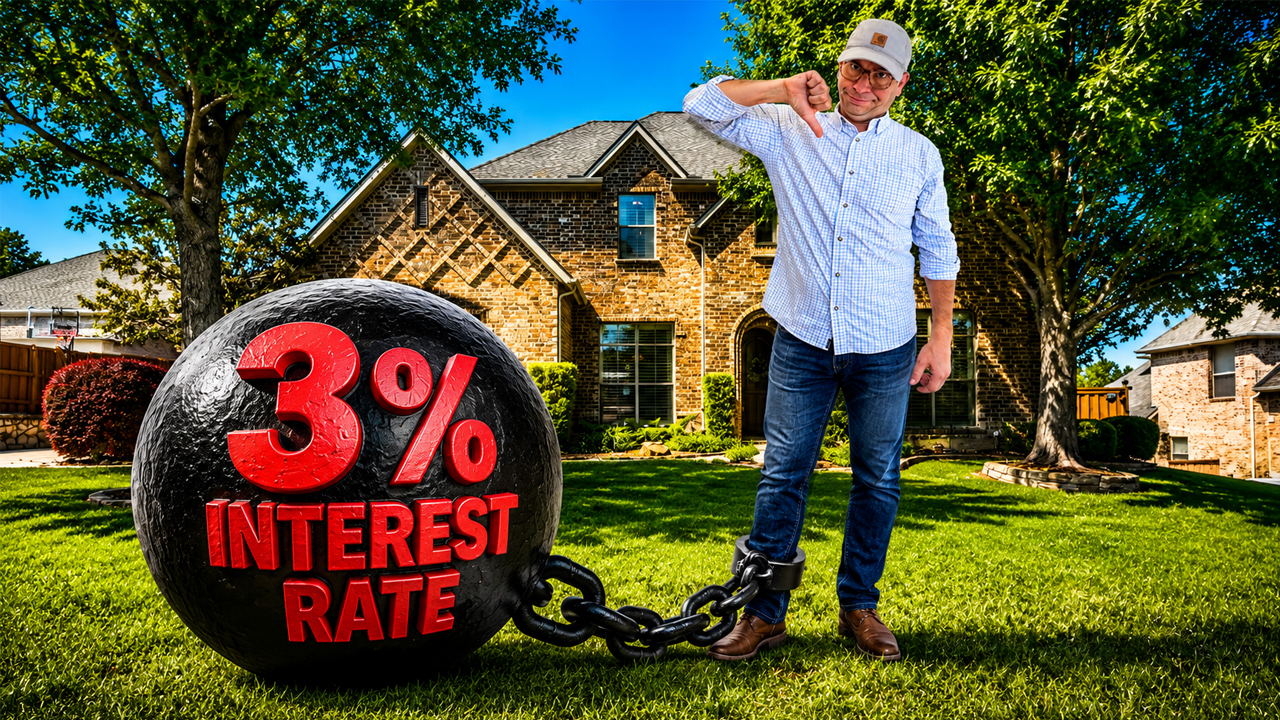
You got the rate.
Maybe it’s 3.75%. Maybe 3.25%. Maybe you’re one of those people walking around with a mortgage rate that starts with a 2.
Congratulations.
Now stop letting it make every other financial decision for you.
Across Dallas-Fort Worth, homeowners are sitting on historically low mortgage rates and understandably reluctant to give them up. That low payment feels like a financial victory because, in many cases, it is.
But a good mortgage rate can become a bad reason to stay in the wrong financial or housing situation.
That’s the part almost nobody is talking about.
The Mortgage Rate Lock-In Effect Is Real
There’s a name for what’s happening: the mortgage rate lock-in effect.
Homeowners who bought or refinanced when mortgage rates were historically low feel tethered to those loans. Selling the home means giving up the low rate and, most likely, taking on a higher rate with the next home.
So they stay.
Sometimes that is absolutely the right decision.
Sometimes it isn’t.
The problem starts when the mortgage rate becomes the entire decision instead of one piece of a much bigger financial and family picture. A low house payment is valuable, but you have to zoom out and look at what your commitment to that payment may be costing everywhere else.
A 3% Mortgage Doesn’t Help Much If You’re Carrying 20% Debt
This is where the math can get ugly.
You may have a beautiful mortgage rate while carrying credit card debt at dramatically higher rates. Maybe you financed cars. Maybe another major expense came along. Maybe life simply got more expensive.
Now you’ve protected the 3% mortgage at all costs while accumulating much more expensive debt elsewhere.
What did you actually protect?
A rate.
Not necessarily your cash flow. Not necessarily your overall financial position. Certainly not automatically your wealth.
That’s the mistake.
Mortgage lender Patrick Glaros, who has served many of our clients, pointed out that homeowners can become so committed to protecting the low rate on their first mortgage that they fail to evaluate their total debt position. The right question isn’t simply, “What’s my mortgage rate?” It’s what all of your debt is costing you together.
That requires actual math.
And no, “But I have a 2.875% mortgage!” is not math.
You May Have More Options Than You Think
Selling your house isn’t necessarily the only way to change your financial picture.
Some DFW homeowners may be able to access home equity while leaving their existing first mortgage in place through a home equity loan or home equity line of credit. Texas has specific rules governing home equity borrowing, so this is something to evaluate with a qualified mortgage professional based on your specific situation.
The point isn’t to go borrow a bunch more money.
Please don’t read that sentence into this article.
The point is that if you’re already carrying expensive consumer debt while sitting on substantial home equity, it may be worth evaluating the whole picture instead of worshipping the interest rate on one loan.
And there is another possibility.
Maybe you actually should sell.
Your Low Interest Rate Can Become Golden Handcuffs
This is the bigger issue for a lot of homeowners.
I’ve spent more than 20 years in Dallas-Fort Worth real estate, and I’ve watched people get remarkably focused on the financial mechanics of a house while ignoring why they wanted a house in the first place.
Your home isn’t just a spreadsheet.
Maybe your family has grown, and you need another bedroom.
Maybe you’re paying private school tuition because you don’t like the schools where you currently live.
Maybe your commute is stealing hours from your family every week.
Maybe you want to be closer to your church, your parents, your grandchildren, or your work.
Maybe the house simply doesn’t fit your life anymore.
But you have a 3% mortgage.
So you stay.
That’s like staying in a job you hate forever because the salary is good. Golden handcuffs are still handcuffs.
Our team has talked about families who may be absorbing costs far beyond the mortgage itself because they’re determined not to move. Private school tuition, additional driving, wear and tear, lost time, and other expenses can all become part of the real cost of staying put.
Again, I’m not telling you to move.
I’m telling you to do the whole math.
DFW Homeowners May Be Sitting on Significant Equity
There’s another side of this conversation that gets ignored.
A lot of Dallas-Fort Worth homeowners who bought several years ago didn’t just get a low mortgage rate. They also experienced substantial appreciation in their homes.
We call this the “unlock effect.” Instead of only asking what you would lose by giving up your low mortgage rate, ask what your accumulated equity could allow you to do.
Could selling allow you to eliminate other debt?
Could your equity become a substantial down payment on the next home?
Could you move into the school district you actually want?
Could you get closer to family?
Could you buy a home that fits the next ten years of your life instead of remaining in one that fit the last ten?
Those questions matter.
The Lowest Mortgage Rate Is Not Automatically the Best Financial Decision
Consumers have been trained to obsess over mortgage rates.
I understand why.
Rates affect payments. Payments affect cash flow. These are real dollars coming out of your bank account every month.
But rate is one variable.
Purchase price matters.
Equity matters.
Other debt matters.
Cash flow matters.
Taxes matter.
Your expected time in the home matters.
And yes, your family matters.
If you can afford to make a move that substantially improves your family’s life, refusing to even evaluate it because you can’t emotionally tolerate replacing a 3% mortgage with a higher-rate loan isn’t automatically financial discipline.
It may just be stubbornness with a calculator.
Should You Sell a Home With a Low Mortgage Rate?
Maybe… and maybe not.
There are absolutely DFW homeowners who should keep the house, keep the low rate, and enjoy both for as long as possible.
But if you’ve wanted or needed to move and your mortgage rate is the primary thing stopping you, get the facts before deciding.
Find out what your current home could realistically sell for.
Find out how much equity you actually have.
Find out what buying the next home would really cost.
Look at your entire debt picture.
Then look at what the move would change for your family.
Now you’re making a decision.
Everything before that is an assumption.
Stop Letting One Number Run Your Life
Your low mortgage rate may be a tremendous asset.
Treat it like one.
But don’t turn it into an idol.
If protecting that rate forces you to carry terrible debt elsewhere, keeps your family in a home that no longer works, prevents you from accessing opportunities created by your equity, or keeps you frozen because “everybody knows” giving up a 3% mortgage is stupid, it’s time to challenge the premise.
The market is always something.
Your job isn’t to wait until every variable is perfect. That’s never coming.
Your job is to get freakishly knowledgeable about your actual options and make the right decision for your family and your finances.
If you’re considering buying or selling a home anywhere in Dallas-Fort Worth, talk with the Todd Tramonte Home Selling Team before you decide what your mortgage rate will or won’t allow you to do.
Visit DallasHomeRealty.com or call 214-216-2161.
Let’s do the math. Let’s look at the life attached to the math. Then let’s make a smart decision.
Frequently Asked Questions
Should I sell my DFW home if I have a 3% mortgage rate?
Not necessarily. A low rate is valuable. The question is whether keeping it still serves your overall financial position, housing needs, and family goals.
Can I use my home equity without giving up my current mortgage?
Potentially. Home equity loans and home equity lines of credit may allow qualifying Texas homeowners to access equity while retaining an existing first mortgage. Texas lending rules apply, so evaluate your specific options with a qualified lender.
Is mortgage rate more important than home price?
No. Rate matters, but so do purchase price, equity, monthly payment, other debt, expected ownership period, and the suitability of the home itself. You can refinance to a lower interest rate, but your sale price is locked in.
Why are DFW homeowners reluctant to sell?
Many homeowners who secured historically low mortgage rates don’t want to replace those loans with today’s higher-rate financing. This is commonly called the mortgage rate lock-in effect.
How do I know whether moving makes financial sense?
Start with the real numbers: your home’s likely selling price, remaining mortgage balance, available equity, other debts, expected purchase price, and estimated payment on the next home. Then evaluate those numbers against what you’re actually trying to accomplish.

