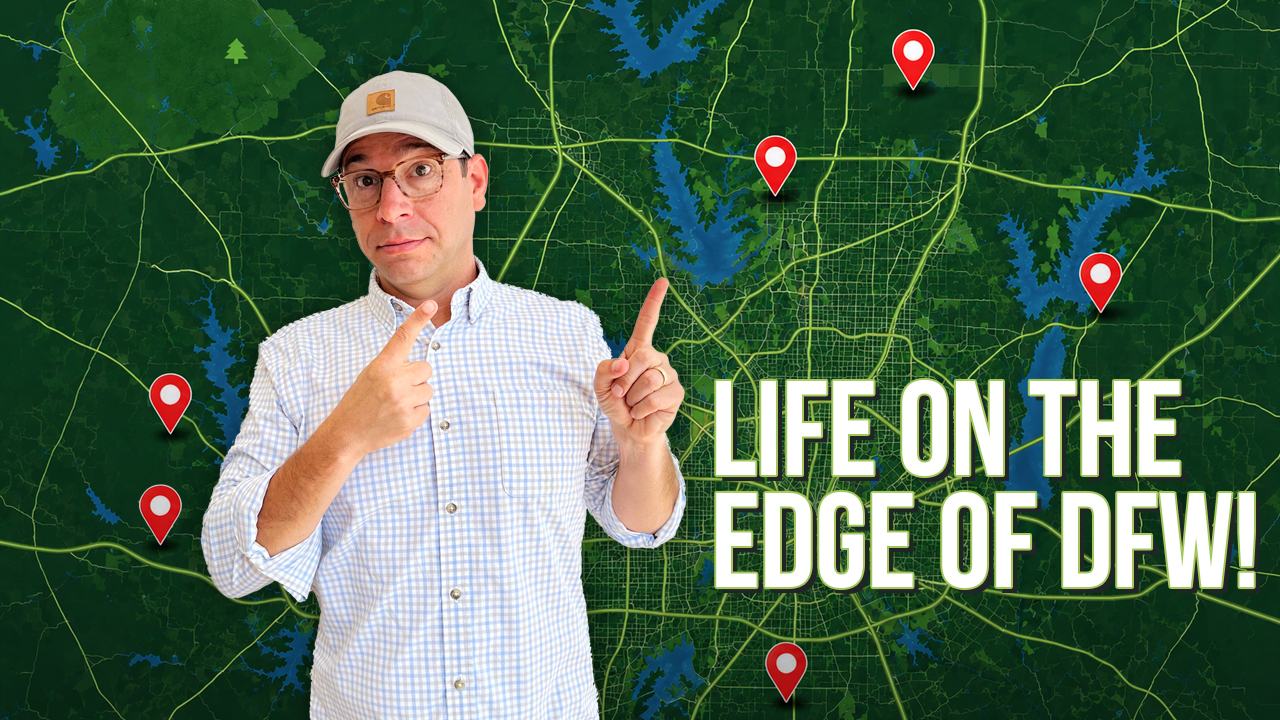
There’s a version of Dallas-Fort Worth that a lot of people want right now.
They want the DFW job market, airports, schools, sports, restaurants, and opportunity. They just don’t necessarily want to live right in the middle of all of it.
They want a bigger backyard.
Maybe an acre.
Maybe a newer house with a third-car garage.
Maybe they’d simply like to drive their kid to school without spending 18 minutes staring at the same brake lights.
That demand has pushed the edges of the Dallas-Fort Worth Metroplex farther and farther out. Places that felt remote 15 or 20 years ago don’t feel particularly remote anymore. And some places that used to be the edge aren’t the edge at all.
Frisco is the obvious example. McKinney is getting there. Benbrook and Aledo used to feel like the western edge of Fort Worth. Now growth continues well beyond it.
DFW keeps moving.
And if you’re buying or selling a home anywhere near that outer ring, you need to understand that the real estate market there can behave very differently from the market closer to Dallas and Fort Worth.
What Do We Mean by the “Edges” of DFW?
There isn’t a perfectly drawn circle around the Metroplex where somebody put up a sign saying, “DFW ends here.”
We generally think of the edge as the outer portion of the continuous Dallas-Fort Worth development. From DFW Airport, you’re often talking about communities roughly 45 minutes to an hour away in normal traffic, although anybody who has driven around here at 5:15 on a Tuesday knows that “normal traffic” deserves some qualification.
Think about places like Anna, Celina, Princeton, Forney, Aledo, Weatherford, Springtown, Haslet, Midlothian, and parts of the growth corridors west of Fort Worth.
Prosper was once a pretty easy example. Today, Prosper feels much more like an extension of Frisco.
That’s how quickly this changes.
To the north, development stretches for miles along the Dallas North Tollway, I-35 and US-75 corridors. East of Dallas, communities including Forney, Princeton, Nevada, and Josephine continue to grow. West of Fort Worth, development has pushed through places like Aledo and toward Weatherford and beyond. Southern DFW has its own growth pattern through communities including Burleson and Midlothian.
The edge isn’t geographically equal in every direction. It follows roads, jobs, schools, development, and available land.
Why Are People Moving to the Outer Dallas-Fort Worth Suburbs?
Money is a big part of it.
For many buyers, moving farther out means getting more house for the budget. That could mean another bedroom, a newer home, a larger lot, a second story, a third-car garage, or simply the ability to own a detached house at all.
We see this especially with entry-level and move-up buyers.
Somebody may love Plano, but their budget doesn’t buy what they need there. Move farther northeast, and suddenly there are possibilities. The same thing happens west of Fort Worth. Buyers who can’t find the combination of house, land, and price they want closer in start looking farther west.
That extra 15 or 20 minutes can change the housing options considerably.
For other buyers, the house isn’t even the main attraction.
It’s the land.
Our team does a lot of business with the half-acre, one-acre, two-acre, and larger residential properties around DFW. These aren’t necessarily farm-and-ranch buyers. They’re people who want a house with an actual backyard. They want a shop, room for the kids, some privacy, space between neighbors, or enough land to look out the window without looking directly into somebody else’s kitchen.
Remote work has made that possible for more families. Homeschooling has changed priorities for some. Business owners and people with side businesses may want room for equipment, vehicles, an office, or a workshop.
Those buyers aren’t necessarily looking for cheaper.
They’re looking for different.
Is Life on the Edge of DFW Really Slower?
Sometimes.
People tell us they want a “slower pace of life,” and I understand what they mean. They usually aren’t asking us to move them to a town in rural New Mexico where the arrival of a second stoplight becomes local news.
They still want DFW.
They just want a little less of it immediately outside their front door.
Maybe school is two minutes from the house instead of 18. Maybe there’s less traffic through the neighborhood. Maybe the backyard feels quiet even though a major grocery store is only a few miles away.
That can be a very good combination.
But there’s a trade-off.
Fewer people can mean fewer restaurants. Less traffic can come with fewer convenient routes. A bigger piece of land may put you farther from youth sports, entertainment, medical facilities, or work.
Some families love that deal.
Some discover that they don’t.
Why Do Some People Move Back Toward Dallas and Fort Worth?
We help people move out to the edges.
We also help people move back.
That surprises people until they’ve lived the trade-off.
Convenience is one of the biggest reasons.
The kids get older, and suddenly the family is driving constantly for sports and activities. Somebody changes jobs. A commute that looked manageable on a map becomes considerably less fun when you do it ten times a week.
Infrastructure matters too.
Fast-growing communities can add houses faster than roads, restaurants, first responders, and other services can keep up. Princeton has been a good example of the challenges that can come with extremely rapid residential growth.
People sometimes buy with the expectation that everything else will arrive immediately.
It doesn’t always.
That doesn’t make the community bad. It means you need to understand what exists today versus what somebody says is coming tomorrow.
Those are two different things.
We’ve also seen people move farther out expecting a particular lifestyle, only to watch development catch them. They moved there because it was quiet and relatively undeveloped. Five years later there are thousands of additional houses.
That’s DFW.
Growth has a way of finding you.
Is It Cheaper to Buy a Home on the Edge of DFW?
Not necessarily.
This is one of the biggest mistakes buyers make when they begin searching the outer Dallas-Fort Worth suburbs.
Farther does not automatically mean cheaper.
The radio-show market snapshot we discussed illustrates the point. At the time of that discussion, median home prices ranged dramatically among communities we would broadly consider part of the outer DFW market. Princeton was around $310,000. Anna was around $350,000. Celina was around $540,000.
Prosper was around $840,000.
For comparison, the figures discussed for several more central or established communities included Plano around $520,000, Allen around $493,000, Richardson around $480,000, and Irving around $360,000.
So no, you cannot simply draw rings around Dallas and assume prices fall as you move farther away.
Prosper is a perfect example. It was once an outer suburb where buyers went to get farther away and potentially get more for their money. Growth changed that equation. Prosper became highly desirable, development accelerated, and prices followed.
Aledo and developments west of Fort Worth can tell a similar story.
Location still matters. So do schools, lot size, home age, neighborhood amenities, new construction, access to major roads, and plain old demand.
The Real Estate Market Can Move Slower on the Outer Ring
There’s another difference sellers need to understand.
Some edge communities can take longer to sell.
According to recent market data, Anna was running around 56 days on market, Forney around 51, Celina around 60, and Prosper around 50.
Compare that with Plano and Richardson at roughly 22 days, Irving at 18 and Lewisville at 23.
That doesn’t mean buyers don’t want the outer suburbs.
They do.
The problem in some communities is supply.
Builders responded to years of enormous demand by building a lot of houses. Then mortgage rates changed. The economy changed. Buyer behavior changed.
Now a resale homeowner in certain outer-ring communities may not simply be competing with the house down the street. You may be competing against dozens of similar homes plus brand-new construction where the builder is offering incentives.
That matters.
A house can be perfectly desirable and still take longer to sell because the buyer has more choices.
This is where sellers get themselves into trouble by assuming the DFW real estate market is one market.
It isn’t.
The market for a house in Richardson can be meaningfully different from the market for a similar-priced house in Celina. A one-acre property outside Aledo behaves differently from a subdivision home in Plano. New construction changes the competitive environment. School districts change it. Commute patterns change it.
Your house does not sell in the “Dallas-Fort Worth market.”
It sells in its specific local market.
That distinction can cost you a lot of money if you ignore it.
Where Are the Edges of DFW Growing?
North Dallas gets a lot of attention because the scale of development is difficult to miss. Prosper, Celina, Anna, and communities farther north have seen substantial growth, and the development along the major northern corridors continues to change what people consider part of the Metroplex.
But this isn’t exclusively a North Dallas story.
East of Dallas, Forney is a major growth area. Princeton has experienced tremendous residential development. Nevada and Josephine continue attracting buyers who want additional space and different price points.
West of Fort Worth, Aledo, Hudson Oaks, Weatherford, Springtown, Azle, Haslet, and the surrounding areas are attracting buyers looking for newer homes, larger lots, and acreage.
South of the core, Burleson, Mansfield, Midlothian, and other communities offer another version of the same basic proposition.
Buying on the Edge Requires More Than Finding a Bigger House
A bigger house can make a buyer forget to ask some pretty important questions.
- How long is the actual commute at the time you’ll be driving it?
- Where is the nearest grocery store?
- What happens when your kids are involved in activities three or four nights a week?
- What development is already approved around the neighborhood?
- How much new construction will you be competing with when you eventually sell?
- What are the roads like now?
- Are you buying the lifestyle that exists or the lifestyle somebody promised you will exist five years from now?
The right answers are different for every family.
I’m not interested in telling everybody they should move to acreage outside Weatherford. I happen to like having some land. Plenty of people would hate it.
There isn’t one correct DFW lifestyle.
There are simply choices and consequences.
The good news is that Dallas-Fort Worth gives you an unusual number of choices. You can live in a downtown condo, an established close-in neighborhood, a master-planned suburb, a newer outer-ring community, or on several acres and still participate in the same broader Metroplex economy.
That’s pretty remarkable.
Selling a Home on the Edge Requires a Different Strategy
If you own a home in one of these growing outer communities, don’t assume population growth guarantees an easy sale.
Sometimes growth creates demand.
Sometimes it creates competition.
If there are three houses for sale in your neighborhood, that’s one thing. If there are 30 resale homes plus two builders offering rate incentives and closing-cost assistance, that is a completely different pricing and marketing problem.
The consumer’s alternatives matter.
This is especially true with larger-lot and small-acreage properties. Buyers looking for half an acre, two acres, or five acres aren’t always searching the same way a typical subdivision buyer searches. The value of the land, improvements, location, access, and property type have to be communicated correctly.
We specialize in these kinds of properties because we like them and because we understand the buyers who want them.
The market is always something.
Your job isn’t to complain about what it is. Our job is to understand it, position the property correctly, and get the best possible result inside the market that actually exists.
Frequently Asked Questions About Living on the Edges of DFW
What areas are considered the edge of the Dallas-Fort Worth Metroplex?
There is no official boundary. Communities such as Anna, Celina, Princeton, Forney, Aledo, Weatherford, Springtown, Haslet, and Midlothian can fit the description, depending on the direction and development corridor.
Are homes cheaper farther outside Dallas and Fort Worth?
Often, but not always. Some outer communities offer more house or land for the money. Highly desirable areas such as Prosper can cost more than established communities closer to Dallas.
Why are people moving to outer DFW suburbs?
Common reasons include newer homes, larger lots, more house for the budget, less traffic, additional privacy, and access to acreage while remaining connected to the DFW economy.
Why do people move back toward central DFW?
Convenience, commuting, jobs, kids’ activities, and access to restaurants, shopping, and services are common reasons. Rapid residential growth can also outpace infrastructure in some developing communities.
Do homes take longer to sell in outer DFW suburbs?
They can. Some outer-ring communities discussed on our show had longer average days on market than established areas such as Plano, Richardson, Irving, and Lewisville. Inventory and competition from new construction can be major factors.
Thinking About Moving Outward or Moving Back In?
Maybe you want the acre.
Maybe you’re currently sitting on the acre thinking, “I would trade half of this backyard for a ten-minute commute.”
Fair enough.
We’ve spent more than 20 years helping people buy and sell homes all over Dallas-Fort Worth, including the larger-lot and small-acreage properties that become more common as you move toward the edges of the Metroplex.
The goal isn’t to talk you into the edge or out of it.
The goal is to make sure you understand exactly what you’re buying, what you’re selling, and what that particular market is doing.
If you’re thinking about buying or selling your next home in Dallas-Fort Worth, call the Todd Tramonte Home Selling Team at 214-216-2161 or visit DallasHomeRealty.com.
We’ll help you figure out where you belong in DFW and then bust our butts to help you get there.

