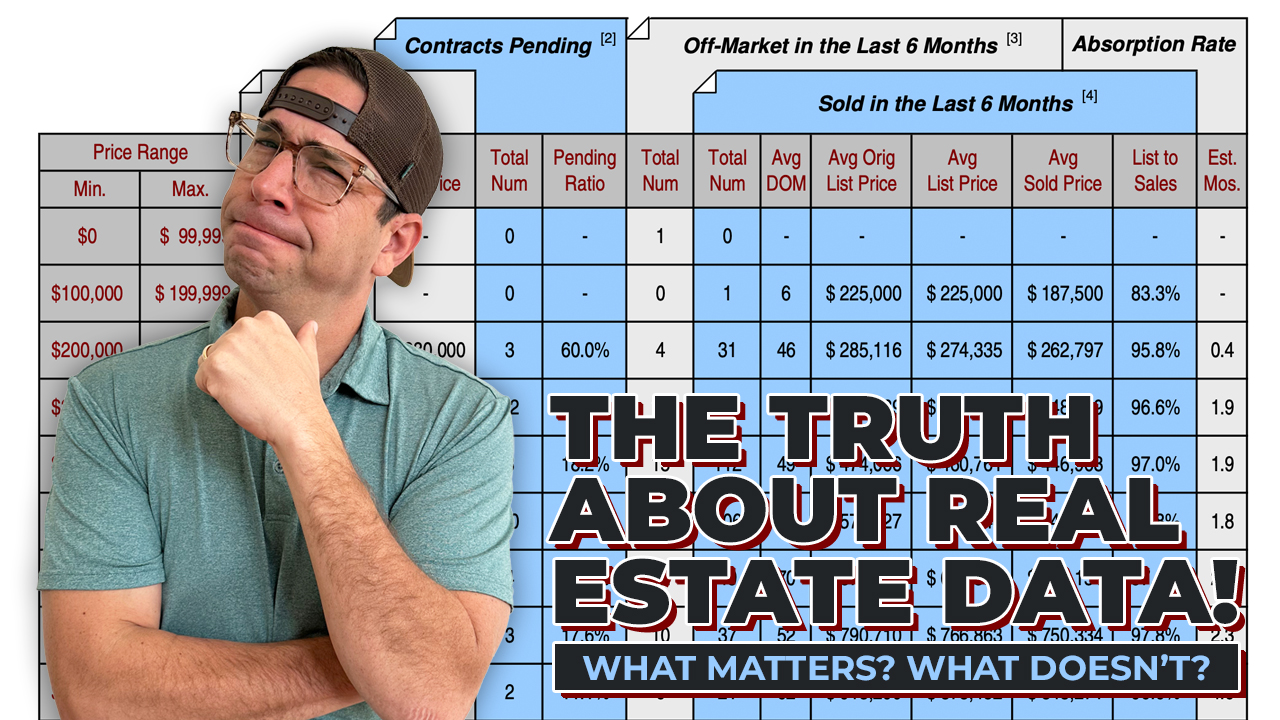
If you follow real estate news, you’ve probably seen headlines like “Home sales drop 22%” or “Prices surge overnight.”These stats sound important, but many of them are misleading, incomplete, or even harmful when making real decisions about buying or selling a home in Dallas-Fort Worth.
Let’s break down why most real estate statistics can’t be trusted at face value, and which ones actually help you make smart moves.
The Problem with Most Real Estate Data
The biggest issue isn’t that statistics are always wrong. It’s that they’re often misused, misunderstood, or taken out of context.
1. Media Prioritizes Attention, Not Accuracy
Most real estate stats you see come from media outlets whose goal is simple: get clicks, views, and engagement. Their goal is not to guide you through your home purchase or sale. They don’t represent you, don’t have a fiduciary responsibility, and aren’t concerned with your financial outcome.
That means headlines are often:
- Oversimplified
- Sensationalized
- Missing key context
2. Small Sample Sizes Skew Reality
A stat like “sales down 22%” sounds dramatic, but what if it’s based on just 10 fewer home sales in a small suburb? If a town has 50 sales one month and 40 the next, should you really lose any sleep over that 20% drop-off? No.
In real estate, especially at the neighborhood level:
- Weather
- Builder inventory
- Timing of listings
- Seasonal shifts
…can all dramatically impact short-term numbers without reflecting the true market.
3. Real Estate Is Hyper-Local
DFW isn’t one market. It’s thousands of micro-markets.
Even within the same:
- City
- Zip code
- Neighborhood
…values can vary based on:
- School zoning
- Street location
- Lot placement
- Nearby development
Broad stats rarely apply to your specific home or situation.
4. Data Lacks Context (Seasonality & Events)
Year-over-year or month-over-month stats often ignore major factors like:
- Interest rate swings
- Economic shifts
- Extreme weather
- COVID-era anomalies
These distort trends and create misleading conclusions.
The Most Misleading Real Estate Stats
❌ List Price to Sales Price Ratio
This is one of the most commonly used and most misleading metrics.
Why it fails:
- Sellers can list at any price
- Some agents intentionally underprice to create bidding wars
- Others overprice and settle lower
A “100% of list price” sale sounds impressive, but is it really that impressive if the home was priced too low and money is left on the table. No.
On the other side of the coin, a smart agent might strategically round up on a list price for the sake of visibility within the market place, understanding there is a chance the home sells for less than list price but more than the comparable market data indicates. That smart agent would have a lower list-to-sales price ratio despite making their client more money!
❌ National or Average Mortgage Rates
You’ll often hear: “Rates are at 6.65%.”
But your actual rate depends on:
- Credit score
- Loan type
- Down payment
- Income and assets
That “average” rate may have nothing to do with your reality.
❌ Broad Market Trends
Statements like:
- “DFW prices are up”
- “The market is cooling”
…ignore the fact that your home’s value is influenced by hyper-local factors, not metro-wide averages.
Why Statistics Get Misused
Even when stats are technically accurate, they can still be misleading because:
- They’re used without context.
- They’re simplified for headlines.
- They’re chosen to support a narrative.
- They ignore local expertise.
In some cases, professionals may even lean on certain stats to persuade decisions that benefit them more than you, intentionally or not.
The Stats That Actually Matter
Now the good news. There are data points that are helpful when used correctly.
✅ Performance vs. True Market Value
Instead of comparing sale price to list price, compare it to:
- Actual market value
- Adjusted for condition, location, and features
This tells you whether a home truly outperformed the market.
✅ Absorption Rate (Months of Inventory)
This is one of the most reliable indicators of market conditions.
It answers:
How long would it take to sell all current homes at the current pace of demand?
How long would it take to sell all current homes at the current pace of demand?
- Low inventory (less than 4 months of inventory) = Seller’s market
- Medium inventory (less than 4-6 months of inventory) = Balanced market
- High inventory (over 6 months of inventory) = Buyer’s market
✅ Hyper-Local Market Data
The most valuable insights come from:
- Recent comparable sales
- Neighborhood-level trends
- Street-by-street nuances
This is where local expertise beats national headlines every time.
✅ Price Elasticity and Real-Time Factors
Price elasticity means your home’s value isn’t fixed. It constantly shifts based on real-world factors. In other words, even small changes around your home or in the market can move your price up or down faster than broad statistics ever show.
Home values shift constantly based on:
- Neighboring property conditions
- New developments
- Zoning changes
- Buyer demand
These factors rarely show up in public stats, but they matter tremendously.
The Bottom Line
Bad data leads to bad decisions.
And in real estate, bad decisions can cost you:
- Tens of thousands of dollars
- Time and opportunity
- Long-term financial growth
Don’t throw the baby out with the bath water. Avoiding data won’t help. It’s all about interpreting data correctly with local expertise and context.
Work with Experts Who Bring Clarity
At the Todd Tramonte Home Selling Team, we pride ourselves on delivering local expertise that inspires clarity and confidence to our clients. We’ll bring you the right data and help you look at it through the proper lens.
We:
- Filter out misleading data.
- Analyze hyper-local market trends.
- Provide customized strategy based on your goals.
So you can make confident, informed decisions without the noise.
Visit DallasHomeRealty.com or call 214-216-2161 to get expert guidance on your next move.
FAQ: Real Estate Stats in DFW
Q: Are real estate statistics ever reliable?
Yes, but only when they’re local and contextualized. A local expert can help interpret them.
Yes, but only when they’re local and contextualized. A local expert can help interpret them.
Q: Why do media reports often conflict with what agents say?
Media focuses on broad trends and engagement, while agents (when good) focus on hyper-local accuracy.
Media focuses on broad trends and engagement, while agents (when good) focus on hyper-local accuracy.
Q: What’s the most important stat for buyers and sellers?
Absorption rate (inventory levels) and pricing relative to true market value.
Absorption rate (inventory levels) and pricing relative to true market value.
Q: Should I ignore national real estate news?
Not entirely, but don’t base decisions on it without local context.
Not entirely, but don’t base decisions on it without local context.
Q: How do I know if the data applies to my home?
Work with a local expert who can interpret stats specific to your neighborhood and property.
Work with a local expert who can interpret stats specific to your neighborhood and property.
:format(webp):quality(80)/u.realgeeks.media/dallashomerealty/modern-home-large-red.png)
:format(webp):quality(80)/u.realgeeks.media/dallashomerealty/map-search-black.png)