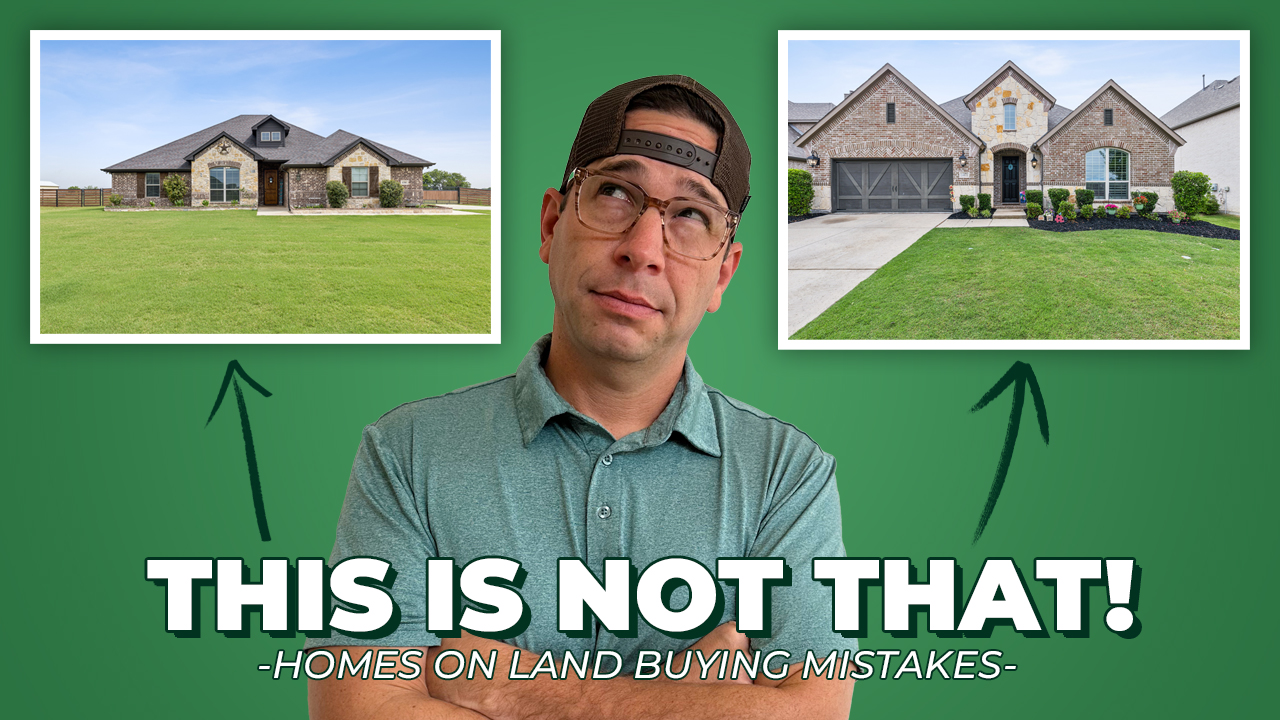
“Oh my gosh… I didn’t know. Someone should have told me.”
You cannot approach buying a home on land the same way you would a home on a standard neighborhood lot. And people do it all the time.
The failure to focus on the numerous little differences between buying a home in a typical neighborhood and a home on small acreage can cost you tens of thousands of dollars and wreck your peace of mind.
Let’s take a look at the consequential, and potentially devastating, mistakes people make when buying homes on land in Dallas-Fort Worth.
The #1 Mistake: Treating Acreage Like a Neighborhood House
When you buy in a typical Dallas-Fort Worth neighborhood, a whole army of people has already thought about things for you.
- The developer had to get grading permits.
- The city required drainage plans.
- Storm sewer systems were engineered.
- Elevation was measured against flood maps.
- Inspections happened.
Is it perfect? No. Is it regulated and engineered? Yes.
Now multiply your lot size by four. Or eight. Or twelve.
That tidy 0.2-acre lot is now 2 acres. Or 5. Or 10.
And suddenly… you’re responsible for things no one else has ever engineered.
That’s where the mistakes start.
Water: The Silent Deal-Killer on Homes With Land
Let me paint you a picture. We had one of those Texas monsoon-style storms recently. Inches of rain in minutes. I watched topsoil, rich, chocolate-milk Texas dirt, literally washing off a property and into the road. Two and a half feet of moving water.
Now imagine that’s your backyard.
Here’s what buyers often don’t think about when purchasing acreage property in DFW:
- Where does water enter the property?
- Where does it leave?
- Does it leave?
- Does it pond?
- Does it backflow from neighboring land?
- Does it sit near the foundation?
- Does it wash out gravel driveways?
In a neighborhood, storm drains handle a lot of that. On acreage? You might have:
- A ditch out front.
- No ditch at all.
- No storm sewer.
- No engineered slope.
- No one but you managing it.
And if you buy in July during a dry spell? You’ll never see the problem. Until you do.
Buying in the Wrong Season (and Never Seeing the Risk)
Here’s a common scenario:
- You view the home in summer.
- It hasn’t rained in weeks.
- The yard looks flat and usable.
- Everything seems fine.
Then you close.
Two days later? Big Texas thunderstorm.
Suddenly:
- The patio floods.
- Half the backyard turns into a swamp.
- Mosquitoes take over.
- Gravel washes into the road.
- Water pools under your pier-and-beam foundation.
And you’re standing there thinking, “Why didn’t anyone tell me?”
Because you didn’t ask the right questions.
And your agent may not have known to ask either.
Soil History Matters More Than You Think
A lot of DFW acreage properties are:
- Former farms
- Old ranch land
- Dairy operations
- Subdivided 80-acre tracts
- Minimally graded 2-acre “communities”
That land may have:
- Compacted soil
- Drainage depressions
- Old pond beds
- Buried debris
- Unknown fill material
Do you know what used to sit on that land?
Because when you buy acreage, you’re not just buying a house.
You’re buying dirt.
And dirt has a history.
Septic, Wells, and What’s Buried Underground
Neighborhood home? You’re likely on city sewer and city water.
Home on land in Dallas-Fort Worth? Maybe not.
You might have:
- A septic system (Where is it? How old? When was it last serviced?)
- A well (What’s the production rate? Water quality?)
- Buried electrical lines
- Surface drainage easements
- Old agricultural infrastructure
At some point, someone dug a hole and buried something.
Do you know what it was?
Because once you close, it’s yours.
Foundation + Drainage = Expensive Lessons
Texas soil moves. Clay expands. Foundations shift.
Now add unmanaged water.
On acreage properties, we often see:
- Water pooling under pier-and-beam homes
- Erosion near slab foundations
- Downspouts dumping at the base of the house
- No defined runoff plan
In a master-planned neighborhood, drainage was engineered.
On raw or semi-developed land? It probably wasn’t.
And that difference can be a five-figure repair.
The “Problem Is the Solution” Mindset
Here’s the good news.
Land gives you options.
Got a low spot that holds water? Maybe that becomes:
- A pond
- A managed drainage basin
- A recreation feature
- A permaculture asset
But that requires intention.
You may need:
- Grading permits
- Berms
- Drainage ditches
- Pumps
- Elevation changes
- Professional planning
Acreage living is incredible, but it’s not passive.
Other Mistakes Buyers Make With Homes on Land
Water is just one prominent example. The bigger issue is this:
People assume everything was already handled.
With acreage, that’s rarely true.
Other common oversights:
- Electrical capacity for outbuildings
- Solar installation feasibility
- Livestock or chicken restrictions
- Fence boundary accuracy
- Easements across the property
- Access for emergency vehicles
- Wind exposure and tree fall risk
- Light pollution or lack thereof
- Road maintenance responsibility
In a more typical neighborhood, there are layers of regulation.
On land? The responsibility shifts to you.
Why Expertise Matters in Fort Worth Acreage Real Estate
When buying or selling a home on land in Fort Worth, you need someone who thinks differently.
Someone who:
- Watches how water moves during storms.
- Pulls flood maps.
- Asks about soil history.
- Evaluates drainage slope.
- Understands septic systems.
- Knows how county regulations differ from city codes.
- Has relationships with inspectors who specialize in rural properties.
Acreage property is not just “more yard.”
It’s a different category of risk.
And a different category of opportunity.
The Bottom Line
If you’re buying:
Slow down.
Ask better questions.
Assume less.
Inspect more.
Ask better questions.
Assume less.
Inspect more.
If you’re selling:
Understand that buyers should be asking these questions, and position your property accordingly.
DFW has some phenomenal homes on land. We love them. We specialize in them. But we also know how quickly a dream property can become a regretful purchase if you approach it like a standard subdivision home.
It’s not the same.
And it shouldn’t be treated the same.
Need Help Buying or Selling a Home on Land in Fort Worth?
Serving home buyers and sellers on transactions involving desirable DFW neighborhood homes, big backyards, and small acreage properties is what we love to do.
It’s what we think about when we’re driving in the rain. It’s how we protect and advocate for you.
If you’re considering:
- Buying a home on acreage in Dallas-Fort Worth
- Selling a home on small acreage
- Evaluating drainage or property risks before listing
Reach out.
We’re here to help you think clearly, move wisely, and avoid the mistakes most people never see coming.
Visit toddtramonteteam.com to connect with our team.