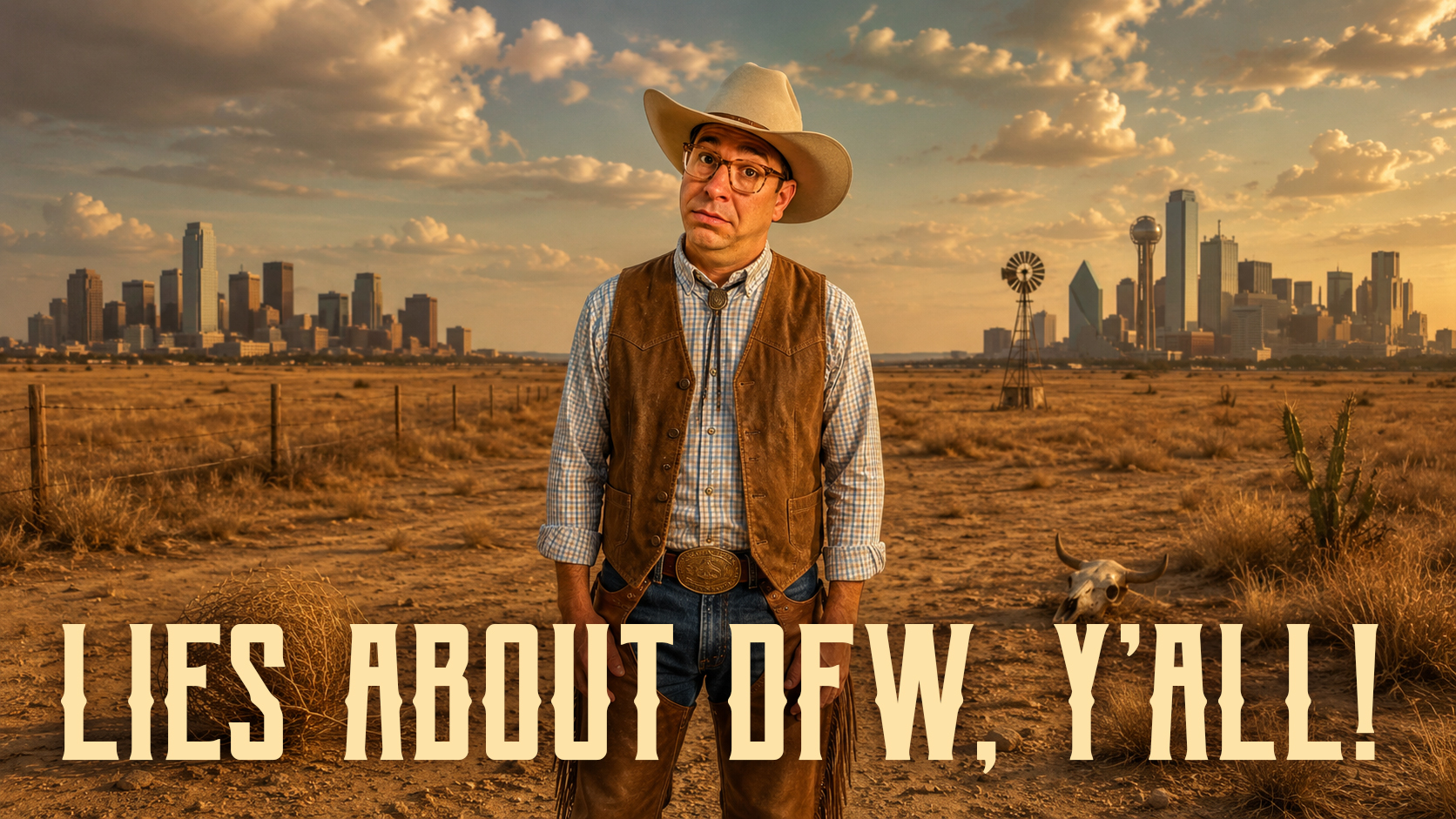
No.
Not even close.
This is one of the most common mistakes I see people make when they start thinking about moving to Dallas-Fort Worth.
They say, “We’re moving to DFW.”
Great.
Where?
“Dallas-Fort Worth.”
That doesn’t really answer the question.
Dallas-Fort Worth is enormous, and the differences between its cities, suburbs, neighborhoods, and even individual streets can completely change what it feels like to live here.
After more than 20 years helping people buy and sell homes across North Texas, I can tell you this: There is no single “DFW lifestyle.”
That’s the lie.
And if you believe it when you’re buying or selling a home, it can become an expensive one.
The Lie: Dallas-Fort Worth Is Basically One Big Place
People outside North Texas understandably tend to think of Dallas-Fort Worth as a single city.
It isn’t.
DFW is a collection of cities, suburbs, neighborhoods, and communities spread across a massive geographic area. Dallas is different from Fort Worth. Allen is different from Richardson. Aledo is different from Keller.
And even saying you want to live in Plano doesn’t necessarily narrow things down enough.
- Which part of Plano?
- What kind of neighborhood?
- What type of house?
- What commute?
- What school district?
- What lot size?
- What price point?
- What do you want your normal Tuesday to look like?
That last question matters more than people think.
Because you aren’t buying “DFW.”
You’re buying a house on a particular street, in a particular neighborhood, inside a particular community. That house is going to affect how you get to work, where you eat, where your kids go to school, what you do on Saturday morning, how much time you spend in the car, and what your life feels like when you come home.
That’s real estate.
And it is incredibly local.
DFW Isn’t One Real Estate Market
This is where the misconception starts costing people money.
You’ll hear somebody say, “The Dallas real estate market is doing this.”
Maybe.
Where?
There are times when buyers have more negotiating power in one part of Dallas-Fort Worth while sellers have more power somewhere else.
One neighborhood may have a large supply of new construction competing against resale homes. Another may have almost no new construction at all.
One area may offer newer homes on smaller lots. Somewhere else, buyers may be able to find older homes, mature trees, and significantly larger lots.
Go a little farther, and you may find small-acreage properties that feel completely different again.
Those aren’t tiny distinctions.
They affect value.
They affect demand.
They affect how we price a home for sale and how aggressively we recommend a buyer pursue one.
They can even change from one side of a street to another.
That sounds ridiculous until you’ve spent a couple of decades selling houses here.
Then it sounds like Tuesday.
Moving to DFW? Start With Your Life, Not a Map
People relocating to Dallas-Fort Worth often begin by looking at houses online.
I understand why.
It’s fun.
It’s also backwards.
A beautiful five-bedroom house at the right price isn’t much of a victory if you discover six months later that you’ve created a miserable commute or chosen a community that doesn’t fit how you actually want to live.
The first question isn’t, “Where can I get the most house?”
The better question is, “What do I want my life here to look like?”
- Maybe you want restaurants and activity nearby.
- Maybe you want quiet.
- Maybe you want a newer suburban home.
- Maybe you want an established neighborhood with mature trees.
- Maybe you want enough land that you can’t reach your neighbor’s house with a decent garden hose.
- Maybe being close to DFW Airport matters enormously because you travel every week.
- Maybe your office location makes one side of the Metroplex dramatically more practical than another.
- Maybe you don’t care about being close to Dallas at all.
Good.
That’s the point.
There isn’t one correct place to live in DFW.
There is a correct fit for you.
Dallas and Fort Worth Aren’t Interchangeable
Even Dallas and Fort Worth themselves have distinctly different personalities.
Fort Worth has held tightly to its Cowtown heritage, and I love that about it. But if your mental picture of Fort Worth is a sleepy little western town with TCU and some cattle, you’re a few decades behind.
Dallas has its own personality, employment centers, neighborhoods, housing stock, and pace.
Then there are all the communities surrounding both cities.
Some are dense and established. Some are growing like crazy. Some offer substantial new construction. Some have older housing and huge trees. Some put you closer to major corporate employment centers. Some offer a slower pace while still keeping you connected to the rest of DFW.
That’s why asking whether Dallas or Fort Worth is “better” isn’t a particularly useful question.
Better for whom?
Better for what?
Those questions we can answer.
The Best DFW Suburb Depends on What You Want
People search online for “the best suburbs in Dallas-Fort Worth” all the time.
I understand the question.
I don’t particularly like the premise.
There isn’t a universal ranking that can tell you where your family should live.
The best DFW suburb for somebody who wants a short commute to a particular office may be completely wrong for somebody who works from home and wants two acres.
A buyer who wants a brand-new house may need a completely different search than someone who would gladly trade new construction for an established neighborhood and mature trees.
- Price matters.
- Commute matters.
- Property type matters.
- Community matters.
- Your priorities matter.
This is also why I wouldn’t make a major relocation decision based solely on a national “Best Places to Live” list.
Those lists don’t know you.
We don’t need to find the place that scored highest on somebody else’s spreadsheet.
We need to find the place where your actual life works.
DFW Can Give You More Choices Than You Think
The size of Dallas-Fort Worth can feel overwhelming when you’re trying to move here.
I think that’s looking at it backwards.
Its size creates opportunity.
Want an urban condo or townhome near restaurants and entertainment? We can find that.
Want the classic suburban neighborhood?
Plenty of options.
Want a larger home for a growing family?
Yep.
Want a house on an acre or two without disappearing into the middle of nowhere?
Those properties still exist too.
- Want older?
- Newer?
- Busier?
- Quieter?
- Closer to Dallas?
- Closer to Fort Worth?
- Closer to an airport?
- Closer to work?
The trick isn’t figuring out whether DFW has what you’re looking for.
It probably does.
The trick is knowing where to look.
That’s where local knowledge becomes incredibly valuable.
Selling a Home in DFW Is Just as Local
This isn’t only a buyer issue.
Sellers get hurt by the same lie.
If you’re selling a home in Dallas-Fort Worth, your competition isn’t every house in DFW.
It probably isn’t every house in your city.
The real question is what other homes a serious buyer will consider instead of yours.
That’s your competition.
Understanding that requires more than looking at a broad Metroplex statistic and sticking a sign in the yard.
- What’s happening in your neighborhood?
- What are buyers comparing your house against?
- Is nearby new construction affecting demand?
- Which features are buyers paying for right now?
- How does your location affect value?
- What makes your property different?
Pricing and marketing a home correctly requires understanding the hyper-local market around that specific property.
DFW is not a commodity.
Your home shouldn’t be treated like one either.
The Truth About Living in Dallas-Fort Worth
The lie is that Dallas-Fort Worth is basically all the same.
The truth is almost the exact opposite.
DFW works so well for so many different people precisely because it isn’t all the same.
You can find different price points, property types, communities, commutes, and paces of life throughout North Texas.
But those choices make local knowledge more important, not less.
The internet can show you 500 houses.
That’s easy.
Knowing which 20 actually fit your life is different.
Knowing which five are worth seriously considering is different again.
And knowing which one you should buy, what you should pay for it, and how you should structure the purchase?
That’s the work.
Frequently Asked Questions About Living in DFW
Is Dallas-Fort Worth all one city?
No. Dallas-Fort Worth is a large metropolitan area made up of Dallas, Fort Worth, and many surrounding cities, suburbs, and communities. Housing, lifestyle, commute times, and property types can vary substantially throughout the area.
What are the best places to live in Dallas-Fort Worth?
There is no single best place to live in DFW. The right area depends on your budget, commute, preferred property type, desired pace of life, and other priorities.
Is Dallas better than Fort Worth?
Neither is universally better. Dallas and Fort Worth offer different lifestyles, housing options, and locations relative to employment and amenities. The better choice depends on what you need from your home and community.
Is DFW a good place to buy a home?
DFW offers an unusually wide range of communities and property types. The key is evaluating the specific neighborhood, property, price, and local market rather than treating the entire Metroplex as one housing market.
Do I need a local real estate agent when moving to DFW?
You need somebody who knows DFW at the local level. When communities, commute patterns, property types, and market conditions can change significantly across the Metroplex, broad market knowledge isn’t enough.
Buying or Selling a Home in Dallas-Fort Worth?
If you’re moving to DFW, moving within DFW, or selling a home here, don’t treat one of the largest and most diverse metropolitan areas in America like one giant neighborhood.
We help hundreds of people every year buy, sell, and figure out what they actually need from their housing. We know these communities. We know the differences. And we’ll bust our butts to help you make a move that works for your family, your finances, and your life.
Work with the Todd Tramonte Home Selling Team.
Visit DallasHomeRealty.com or call 214-216-2161.
Don’t just find a house in DFW.
Find the right one.
:format(webp):quality(80)/u.realgeeks.media/dallashomerealty/modern-home-large-red.png)
:format(webp):quality(80)/u.realgeeks.media/dallashomerealty/map-search-black.png)